
In Human Resources, predicting human behavior is the ultimate goal. For decades, organizations relied on binary archetypes to categorize talent. Modern Industrial-Organizational (I-O) psychology has since moved toward a more rigorous, empirical framework.
The Big Five personality model (often abbreviated as OCEAN) is currently the most scientifically validated framework for understanding personality in the workforce.
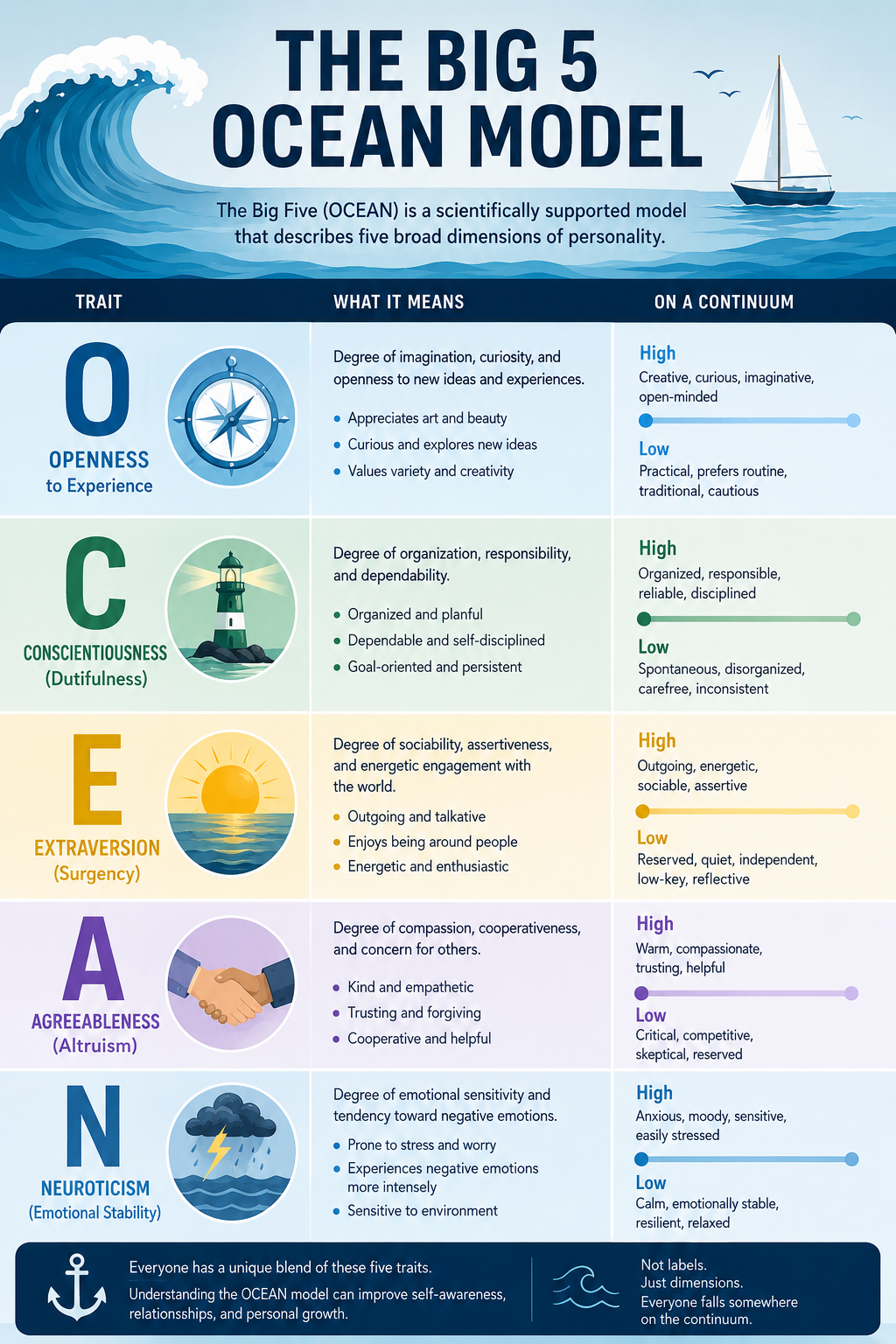
Why the Big Five? The Predictive Power of Data
Unlike popular type-based assessments that often lack predictive validity (the ability to forecast future performance), the Big Five is built on decades of lexical research and factor analysis. It recognizes that personality isn't fixed but exists on a spectrum of intensity.
Understanding the Five Continuums (The OCEAN Facets)
- Openness:Inventive & curious vs. consistent & cautious. Driving force of innovation and adaptability.
- Conscientiousness:Efficient & organized vs. extravagant & careless. The single strongest predictor of overall job performance.
- Extraversion:Outgoing & energetic vs. solitary & reserved. Key indicator for leadership and collaborative potential.
- Agreeableness:Friendly & compassionate vs. critical & rational. Measures cohesion and conflict management.
- Emotional Stability:Resilient & confident vs. sensitive & nervous. (Often called Neuroticism in clinical settings). Defines stress management and resilience.
Personality is not a destiny; it is a baseline. For the Kaizen HR professional, measurement is not about 'labeling' employees but providing the self-awareness required for continuous improvement.
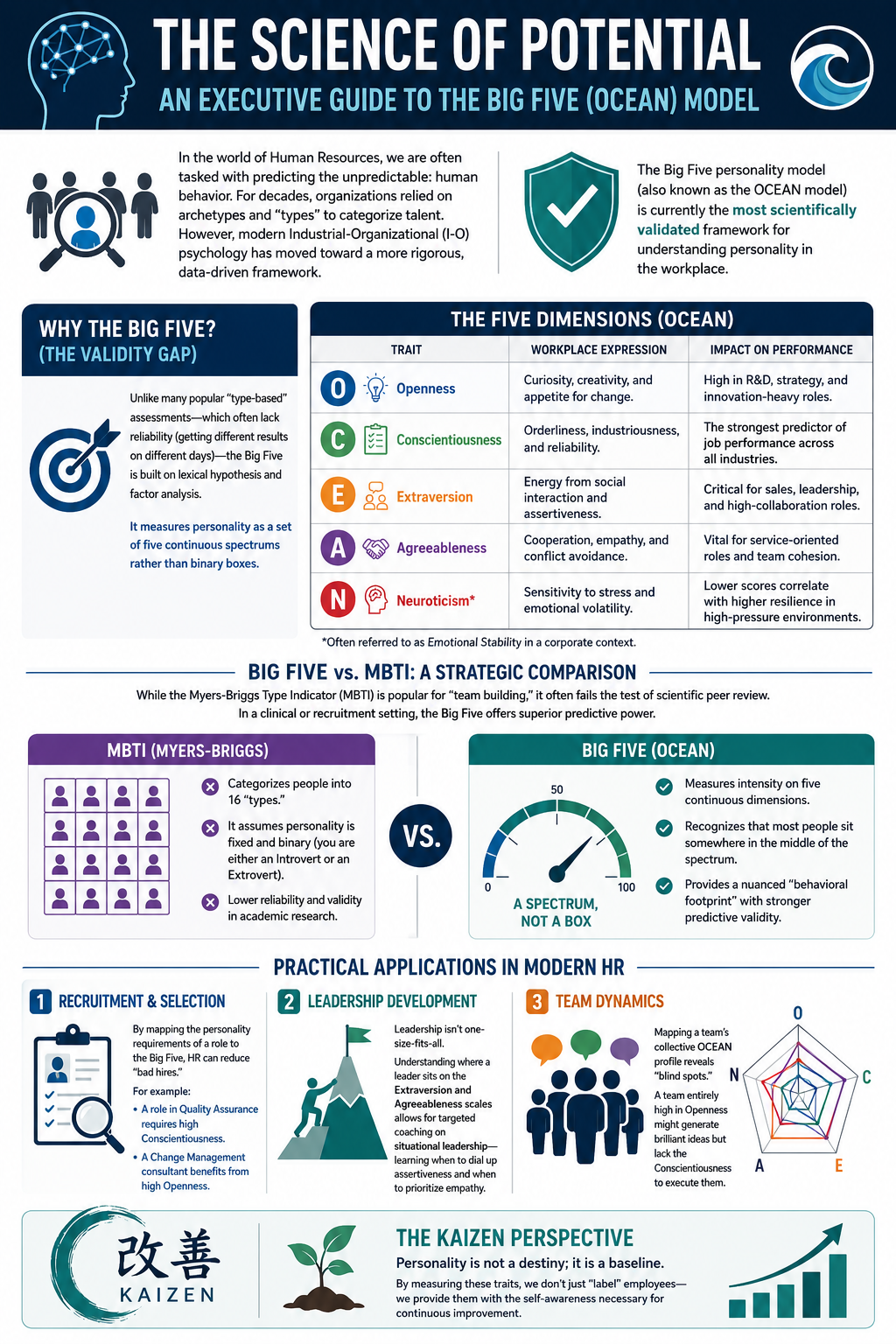
Big Five vs. MBTI: The Battle for Strategic Relevance
A common mistake in HR strategy is deploying tools designed for entertainment (like many type indicators) in high-stakes clinical or recruitment environments. While popular for team-building, the binary nature of MBTI fails the test of scientific rigor required for evidence-based people management.
Categorizes people into 16 binary 'types'. It assumes you are either an Introvert or an Extrovert, disregarding the reality that personality is a sliding scale.
Measures intensity. It reveals your unique 'behavioral footprint' by showing where you sit on five spectrums, providing the data needed for granular coaching.
Strategic Applications Across the Employee Lifecycle
The true value of the Big Five is unlocking a data-driven approach to every phase of the strategic employee journey.
1. Recruitment & Selection (Reducing Bad Hires)
Map the requirements of a role to the necessary Big Five intense. For example, R&D strategy benefits from high **Openness**, while Quality Assurance requires high **Conscientiousness.**
2. Leadership Development (Targeted Coaching)
Understanding where a leader sits on the Extraversion and Agreeableness spectrum allows for surgical coaching—learning when to dial up assertion and when to prioritize empathy.
3. Team Dynamics (Closing Blind Spots)
Mapping a team's collective OCEAN profile reveals invisible risks. A team high only in Openness will generate brilliant ideas but may lack the Conscientiousness required to execute them.
Ready to map your strategic behavioral footprint?
Unlock immediate self-awareness and professional growth with our scientifically validated core diagnostic. Data-driven Kaizen starts here.
Map My Profile